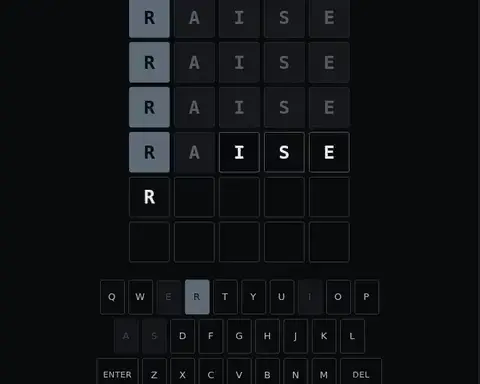
A five-letter word game gives you six attempts and three signals per letter: right place, wrong place, or not present. That is a surprisingly rich information channel, and most people waste the first third of it by treating their opening word as an attempt to win rather than an attempt to learn.
The opener is an instrument, not a guess
On turn one you know nothing. Every letter you test returns information regardless of whether it appears, because "not present" eliminates a huge number of candidates. The best opening word is therefore the one that tests the most useful letters, not the one most likely to be the answer.
What makes a letter useful:
- Frequency. E, A, R, O, T, L, I, S, N and C appear in far more five-letter words than J, Q, X and Z.
- Positional information. A letter that commonly appears in several positions tells you more than one that is almost always at the end.
- Distinctness. Repeating a letter in your opener wastes a slot — the second E tells you almost nothing the first one did not.
Words that satisfy all three well include CRANE, SLATE, TRACE, CRATE and STARE. These are not magic; they simply pack five high-frequency, well-distributed, distinct letters into one attempt.
Which of them is best is a question with an actual answer, and we computed it against this game's own 760-word answer list rather than borrowing a figure from an analysis of a different one. TRACE finishes fastest at 3.06 guesses on average; STARE carries the most information but finishes slightly slower; and CRANE, the most-recommended opener on the internet, is one of only two words tested that ever needs a seventh guess here. The workings are in the best opening word for Word Guess.
Should you use a fixed opener?
Yes, at least while you are learning. A consistent opener means you build intuition about what its feedback patterns imply. If CRANE returns a present R and nothing else, you learn over dozens of games what that tends to mean. Randomising your opener throws that experience away.
The second guess: cover, do not converge
This is where most games are decided, and where most players go wrong. After a weak first result — say one present letter — the instinct is to start building candidate words around it. Resist that for one more turn.
A second word that tests five entirely new letters gives you ten letters of coverage out of the twenty-six, which typically narrows the answer to a handful of possibilities. A second word built around your one known letter might test only two new ones.
Good second words pair naturally with a common opener because they use what it did not. After CRANE, words like MOIST, DOILY or PUDGY sweep a different part of the alphabet.
The exception: if your first guess returned three or four correct-position letters, converge immediately. Information gathering has already done its job.
Reading the tiles properly
A correct-position tile
Fully resolved. Lock it and never move it. The most common avoidable error in these games is submitting a word that contradicts a known green position.
A present tile
This is the informative one, and it says two things: the letter is in the word, and it is not in the position you just tried. Both halves matter. Move that letter at least one position — and where possible, two, because adjacent positions in five-letter words are heavily correlated.
An absent tile
Usually means the letter is not in the word at all. The important caveat is repeats: if you guess SPEED and the answer contains exactly one E, one of your two Es comes back present or correct and the other comes back absent. It does not mean E is absent — it means there is not a second one.
Double letters, the sixth-line killer
Roughly one in five common five-letter words contains a repeated letter. Words like SPELL, GEESE, ABBEY, KNOLL and SASSY are what remain when you have four positions locked and nothing fits.
The tell: you know four positions, you have eliminated most of the alphabet, and no word made of your remaining unused letters fits. At that point, stop looking for a new letter and start asking which known letter could appear twice.
Read the keyboard, not the grid
By the fourth guess, the on-screen keyboard holds more usable information than the tiles do. It shows, at a glance, the letters you have eliminated and the letters you have never tested.
Scan the untested letters before committing. If your candidate word uses only letters you have already tried, it is probably not narrowing anything — and if two candidate words both fit your constraints, prefer the one that tests an untested letter, even if you think it is less likely to be the answer.
The endgame trap
You have four letters locked and the remaining position could be one of five consonants: _ATCH could be BATCH, CATCH, HATCH, LATCH, MATCH, PATCH or WATCH. You have two guesses left and seven candidates.
Guessing them one at a time is a losing proposition. The better move — if you can afford one guess — is to play a word that tests several of those candidate consonants at once, even though it cannot be the answer. Something containing B, C and M in any arrangement resolves the whole family in a single attempt.
This feels like wasting a turn. It is the opposite: it converts a one-in-seven gamble into a certainty.
A workable game plan
- Guess 1: fixed opener, five distinct high-frequency letters.
- Guess 2: five new letters, unless guess 1 gave you three or more greens.
- Guess 3: start converging. Use everything you know; prefer candidates that test an untested letter.
- Guess 4: if more than three candidates remain, play a disambiguating word rather than a candidate.
- Guesses 5–6: commit. Check for double letters before you submit.
Played this way, most games finish on guess three or four, and the sixth line stops being a place you visit regularly.