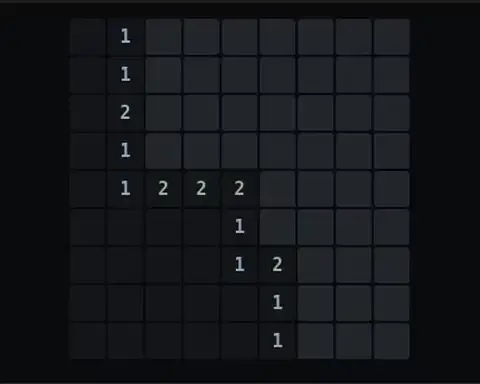
Minesweeper has a reputation for being a coin flip. It is not. Every number on the board is a complete statement — "exactly this many of my eight neighbours are mines" — and almost every position you will encounter resolves from those statements alone. What separates a fast player from a frustrated one is recognising four shapes on sight.
The foundation: counting flags
Before any pattern, there is one rule that does most of the work. Take any revealed number. Count the flags already touching it.
- If the flag count equals the number, every remaining hidden neighbour is provably safe. Open them all.
- If the number of hidden neighbours equals the number minus the flags, every one of them is a mine. Flag them all.
That is the entire logical core of the game. Everything below is a shortcut for applying it to shapes that recur often enough to be worth memorising.
Pattern 1: the 1-1 along a wall
Two adjacent 1s sitting on the edge of the revealed region, with unopened cells beneath them.
? ? ?
1 1 x
■ ■ ■   ← revealed
The left 1 touches two hidden cells. The right 1 touches those same two, plus one more further right. Since the left 1 accounts for exactly one mine among the first two cells, and the right 1 also accounts for exactly one mine — and it must be the same mine — the third cell cannot contain one. It is safe.
This is the pattern that lets you make progress along a wall without ever guessing. Whenever you see two 1s side by side at the frontier, the cell just past the pair is safe.
Pattern 2: the 1-2-1
Three consecutive numbers reading 1, 2, 1 along a straight line, with three hidden cells beneath.
? ? ?
1 2 1
■ ■ ■
The answer is always: mine, safe, mine. The two outer cells are mines and the middle one is clear.
The reasoning: the 2 in the middle needs two mines among the three hidden cells. Each 1 needs exactly one mine among the two cells it touches. If the middle cell were a mine, both 1s would be satisfied by it alone, leaving the 2 needing a second mine from cells that the 1s have already declared empty — a contradiction. So the middle cell is clear, and the 2's two mines must be the outer cells.
1-2-1 appears constantly, particularly along the top and bottom edges of a board. Learn it first.
Pattern 3: the 1-2-2-1
Four consecutive numbers, four hidden cells beneath.
? ? ? ?
1 2 2 1
■ ■ ■ ■
Here the result is: safe, mine, mine, safe. The two middle cells are mines, the outer two are clear.
It is the mirror image of 1-2-1 and follows the same style of argument. If either outer cell were a mine, the adjacent 2 would have to find its second mine somewhere the neighbouring 1 has ruled out. So the mines sit in the middle.
Pattern 4: the 1-2 corner
A 1 and a 2 adjacent, where the 2 has exactly one hidden neighbour the 1 does not touch.
? ? ?
1 2 ■
The 2 needs two mines. The 1 permits at most one among the cells they share. Therefore the cell that only the 2 touches must be a mine. Flag it, and now the flag-count rule usually cascades into several more resolutions.
This is the most useful of the four in the middle of a board, where clean straight-line patterns are rarer.
The opening: why the first click is free
In every modern implementation, including this one, the mine layout is generated after your first click, guaranteeing it is not a mine and usually that it opens a large empty region. This turns the opening from a coin flip into a real decision.
Click near a corner or an edge rather than the centre. Edge cells have fewer neighbours, which means the numbers they generate are more constrained and produce cleaner deductions. A centre opening tends to produce a large blob surrounded by ambiguous 2s and 3s.
To flag or not to flag
Competitive players often skip flagging almost entirely, because placing a flag costs a click and the fastest solvers hold the mine positions in their head. For everyone else, flagging is worth it — not because the game requires it, but because it converts a hard memory problem into an easy visual one.
A reasonable middle ground: flag when a region gets complicated, and skip flags in areas where the numbers are all 1s and the deductions are obvious.
When you genuinely have to guess
Some board states are provably ambiguous. Two configurations both satisfy every number, and no amount of logic distinguishes them. This is not a failure of your reasoning — it is a property of the board.
When it happens:
- Exhaust the whole board first. A deduction available in a far corner may cascade back and resolve the ambiguity. Most "forced guesses" are not forced.
- Count remaining mines. The mine counter is information. If three mines remain and one region has four candidate cells while another has three certain ones, the arithmetic often decides it.
- Guess in the corner. Corner cells have three neighbours instead of eight. A wrong guess there reveals less and, if you survive, the resulting number is more constrained.
- Guess away from your progress. If you must gamble, do it in a region you have not developed, so a loss costs less accumulated work.
Realistic times
| Difficulty | Size | Mines | A good time |
|---|---|---|---|
| Beginner | 9 × 9 | 10 | Under 15 seconds |
| Intermediate | 16 × 16 | 40 | Under 60 seconds |
| Expert | 30 × 16 | 99 | Under 200 seconds |
World-record times are far below these — under 40 seconds on Expert — but those runs involve no flagging, extensive chording, and a substantial amount of luck in the opening. For a player who knows the four patterns, the times above are a reasonable target within a few weeks.